
A Simple Morning Habit to Strengthen Emotional Awareness and Executive Function

Updated: Apr 21
Wondering how to improve your executive function skills as an adult?
Take our free, 2-minute quiz to find out which executive function skill you should start with.
Thank you to our sponsors who keep this newsletter free.
Emotional control is one of the most important executive function skills for neurodivergent adults, yet it’s also one of the least understood. If you have ADHD or are autistic, your emotions often shape your day before you even realize it.
This article will show you how to use Dr. Marc Brackett’s Mood Meter to increase emotional awareness and strengthen emotional control. With a simple daily check-in, you can start each morning grounded instead of overwhelmed.
Table of Contents
Hi Friend,
I believe emotional control is the most underrated executive function skill.
Our emotions shape every decision we make throughout the day, and when we aren't aware of them, the results aren’t great.
Last week was a perfect example.
I woke up early, ready to write, and immediately spilled coffee all over my desk. Nothing was ruined. It took maybe 30 seconds to clean up. But I spiraled.
Frustration turned into anger, which morphed into that familiar self-shaming voice: What is wrong with me? I always screw things up.
Before I knew it, my amygdala had taken over. My chest tightened, my creativity disappeared, and I sat frozen while my thoughts spun out of control.
This isn’t unusual for me. December is one of the most stressful months of the year. I feel guilty writing this because the holidays should be an exciting time: family, good food, gift giving.
All things I’m incredibly grateful for.
But year after year, I find myself overwhelmed, dysregulated, and exhausted. It’s not how I want to feel this year.
With the holidays approaching, I needed a different approach. A few months ago, I was introduced to Dr. Marc Brackett’s Mood Meter. This tool turned out to be exactly what I needed.
After using it consistently for two months, I notice emotions as they rise instead of when it's too late.
Small hiccups, like spilled coffee, don’t ruin my morning.
And honestly, I’m just happier.
Today, I want to show you how to use the Mood Meter to improve your emotional intelligence and emotional control.
Let’s dive in.
What the Mood Meter is and Why it Works
Wouldn’t it be great to wake up excited for the day? Instead, many neurodivergent adults start the morning overwhelmed, overstimulated, or already dysregulated.
We grab our phones before checking in with ourselves. We rush around trying to beat traffic or get the kids ready. By the time we get to work, our amygdala is firing, our prefrontal cortex (where our executive function skills live) is offline, and our emotions are running the show.
When this becomes the norm, our ability to focus, plan, communicate well, and manage self-talk deteriorates fast.
The Mood Meter, created by Dr. Marc Brackett of the Yale Center for Emotional Intelligence, changes this.
It contains four quadrants:
Red = high energy, low pleasantness
Blue = low energy, low pleasantness
Yellow = high energy, high pleasantness
Green = low energy, high pleasantness
With this tool, emotional control, an advanced executive function skill, feels simple.
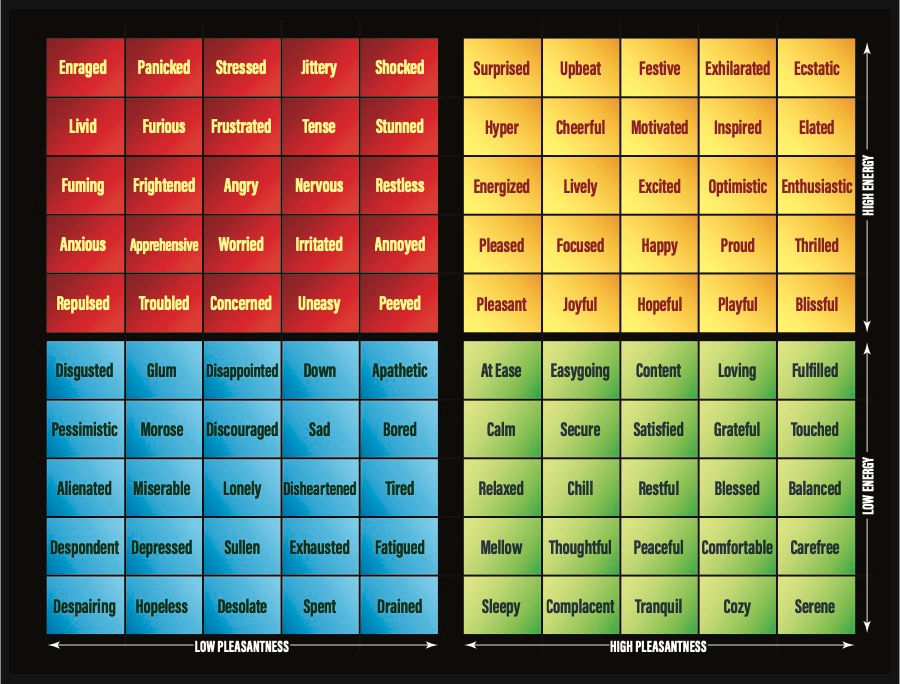
In less than 30 seconds, we practice emotional intelligence by naming how we feel without trying to change it.
The more we do this, the executive function skill of emotional control strengthens. Then, throughout the day, we become more intentional:
Small hiccups don’t derail progress.
We pause before reacting.
We show up as the person we want to be.
So if it’s this simple, why do neurodivergent adults with ADHD or who are autistic struggle with emotional control?
Common Mistakes That Block Emotional Control
For years, our society believed being in touch with our emotions was a sign of weakness. A “soft” skill.
It’s not.
In fact, one study found that people with stronger emotional control had better problem-solving skills, more meaningful careers, and were more likely to feel successful.
But for many neurodivergent people, especially men, this belief has held us back.
We are experiencing a societal shift. Now, meditation, journaling, and emotional intelligence are seen as performance tools.
However, my self-determination and executive function coaching clients often make these mistakes when trying to improve emotional control:
They wait until they are overwhelmed or after rejection-sensitivity kicks in before checking in.
Then, we make impulsive purchases, say things we regret, or get so deep in the shame spiral that our entire day is ruined.
They believe they don’t have time to practice emotional awareness.
With long to-do lists and demands from our bosses, prioritizing an emotional check-in feels like adding another task.
They mislabel what they feel, making regulation harder.
Most of us were not taught this skill in school. Fear is easily confused with anxiety. Boredom is difficult to differentiate from confusion. Then, we freeze, avoid, or distract ourselves.
The Mood Meter solves these problems. It is proactive, rather than reactive, and takes less than 30 seconds.
A Simple Morning Habit to Strengthen Emotional Awareness and Executive Function
The Mood Meter can be used as a simple morning habit to strengthen emotional awareness and executive function. I use it each morning.
Keep this in mind: the goal is not to change your emotional state. It’s noticing it.
Step 1: Pause
Choose a moment in your morning to practice this strategy. Ideally, it’s before you grab your phone.
Remembering a new routine, especially with ADHD. I used James Clear’s Temptation Bundling strategy and paired it with my morning cup of coffee.
Step 2: Determine your quadrant
Ask yourself: Is my energy high or low? Am I feeling pleasant or unpleasant?
This tells you which quadrant you’re in.
Step 3: Name the specific emotion
Find one (or a few) emotions on the Mood Meter that match how you feel. No judgment. No pressure to understand why. No pressure to change.
This is the foundation of emotional awareness, which strengthens the executive function skill of emotional control.
You can find our guide to using the Mood Meter here.
Summary
Emotional control is a foundational executive function skill. Every decision we make, every action we take, is fueled by our emotional state.
For some, this EF skill is more challenging. Small mistakes cause us to spiral, we snap at people without knowing why, and live in a constant state of stress.
This doesn’t mean you’re broken. It’s a sign of an executive function skill you can improve.
Dr. Marc Brackett’s Mood Meter can help.
In less than 30 seconds, we can do an emotional check-in. Over time, these check-ins build our emotional intelligence and control.
Here’s how:
Pick a time to pause.
Grab your Mood Meter.
Determine your quadrant.
Name how you feel.
My challenge for you: one Mood Meter check-in each morning before you touch your phone this week.
This tiny act increases emotional awareness, improves executive function skills, and helps you start the day grounded instead of reactive.
Remember, the goal of emotional control isn’t to fix how we feel. It’s noticing it.
In service,
Eric
FAQs
What is the Mood Meter, and how does it help with emotional control?
The Mood Meter, created by Dr. Marc Brackett at the Yale Center for Emotional Intelligence, is a simple tool that helps you identify your emotional state in less than 30 seconds.
By noticing your energy and pleasantness levels, you can locate yourself in one of four quadrants: red, blue, yellow, or green. This awareness strengthens the executive function skill of emotional control because it helps you respond intentionally instead of reacting on autopilot.
For adults with ADHD or autism, this quick check-in makes it easier to manage stress, communicate clearly, and make better decisions throughout the day.
How can the Mood Meter help neurodivergent adults with ADHD or autism improve executive function skills?
Emotional awareness is directly tied to executive function skills like planning, focus, task initiation, and self-regulation. Many neurodivergent adults struggle with emotional control because they notice their emotions only after they feel overwhelmed. The Mood Meter is proactive. A daily check-in helps you identify emotions before they take over, which improves emotional control and reduces reactivity. Over time, this builds stronger executive function skills that support better work performance, healthier relationships, and less daily stress.
When is the best time to use the Mood Meter during the day?
For most people, especially neurodivergent adults, the best time to use the Mood Meter is in the morning before checking your phone or email. This prevents outside stress from shaping your emotional state before you know how you actually feel.
A quick check-in also helps you structure your day more intentionally based on your energy and emotional needs. You can use the Mood Meter anytime you feel overwhelmed, stuck, or reactive, but one consistent morning check-in is enough to build emotional control and improve executive function skills over time.
Related articles:
P.S. Free Mini Course: Break the Procrastination Cycle
Procrastination can seriously impact your mental health, physical well-being, and financial freedom.
My free mini-course, Break the Procrastination Cycle, teaches the 4 emotions behind procrastination, how to spot them, and a proven toolkit to manage them—all in just 30 minutes
If you or someone you care about struggles with procrastination, this course is here to help.
yes
About the Author

Eric Kaufmann is an Educational Therapist, Certified Executive Function Coach, and speaker. He is the Co-founder of UpSkill Specialists, an executive function coaching company that helps adults and workplace teams overcome disorganization, procrastination, and productivity roadblocks. Eric is also the founder of Elevate Learning Solutions, an Educational Therapy practice that supports neurodivergent students in becoming independent and confident. Book Eric to speak or lead a workshop.


